+86-20-86215789 service@adhesive-dy.com

Views: 0 Author: Site Editor Publish Time: 2026-08-04 Origin: Site
Structural integrity in modern construction relies on accommodating dynamic movement rather than rigidly resisting it. Building materials continuously expand and contract due to thermal cycling, wind loads, seismic activity, and natural settlement. Specifying inflexible fillers like mortar or chemically incompatible sealants inevitably leads to cohesive failure. This creates water ingress, substrate damage, and extensive remediation work. You need materials designed for elasticity and long-term environmental exposure. We evaluate how the elastomeric properties, moisture-curing mechanism, and non-corrosive chemistry of Neutral Silicone Sealant provide a reliable, long-term solution for dynamic joint sealing without compromising sensitive substrates.
Movement Capability Dictates Specification: Sealants rated for ±25% to ±50% movement are critical baseline requirements for dynamic construction joints.
Chemical Compatibility is Non-Negotiable: Neutral cure formulations release alcohol or oxime during curing, preventing the corrosion of metals and the staining of porous masonry that acetoxy sealants cause.
Joint Geometry Drives Performance: Even premium sealants fail without proper joint design; maintaining a strict width-to-depth ratio and utilizing bond breakers prevents catastrophic three-sided adhesion.
Long-Term ROI: The inorganic siloxane polymer backbone of 100% silicone offers superior UV and weather resistance compared to organic polyurethanes, reducing lifecycle maintenance costs.
Building joints never remain static. They experience continuous dimensional changes driven by environmental and structural forces. Thermal expansion and contraction represent the most common sources of movement. Different building materials possess varying coefficients of thermal expansion. Aluminum frames expand significantly more than adjacent concrete panels under the same temperature increase. This differential movement creates immense shear and tensile stress at the joint interface.
Moisture-induced swelling also forces joints to shift. Porous materials like brick and concrete absorb atmospheric moisture and expand. As they dry, they shrink. Structural deflection adds another layer of complexity. Floor slabs and facade panels deflect under live loads, dead loads, and wind pressure. Continuous vibration from heavy traffic, internal machinery, or minor seismic events further subjects the building envelope to high-frequency micro-movements. Sealants must absorb all these forces simultaneously without breaking their bond to the substrate.
Thermal Expansion Coefficients of Common Building Materials
Material | Approximate Coefficient of Thermal Expansion (10^-6/°C) | Practical Field Impact on Joint Design |
|---|---|---|
Aluminum | 21.0 - 24.0 | High movement. Requires wide joints and high-movement elastomeric sealants. |
Concrete | 10.0 - 14.0 | Moderate movement. Prone to cracking if rigid fillers restrict expansion. |
Steel | 11.0 - 13.0 | Moderate movement. Often dictates the baseline structural shift in commercial framing. |
Glass | 8.5 - 9.0 | Low movement. Highly rigid, transferring stress directly to the perimeter sealant. |
Brick / Masonry | 5.0 - 7.0 | Low thermal movement, but highly susceptible to moisture-induced swelling. |
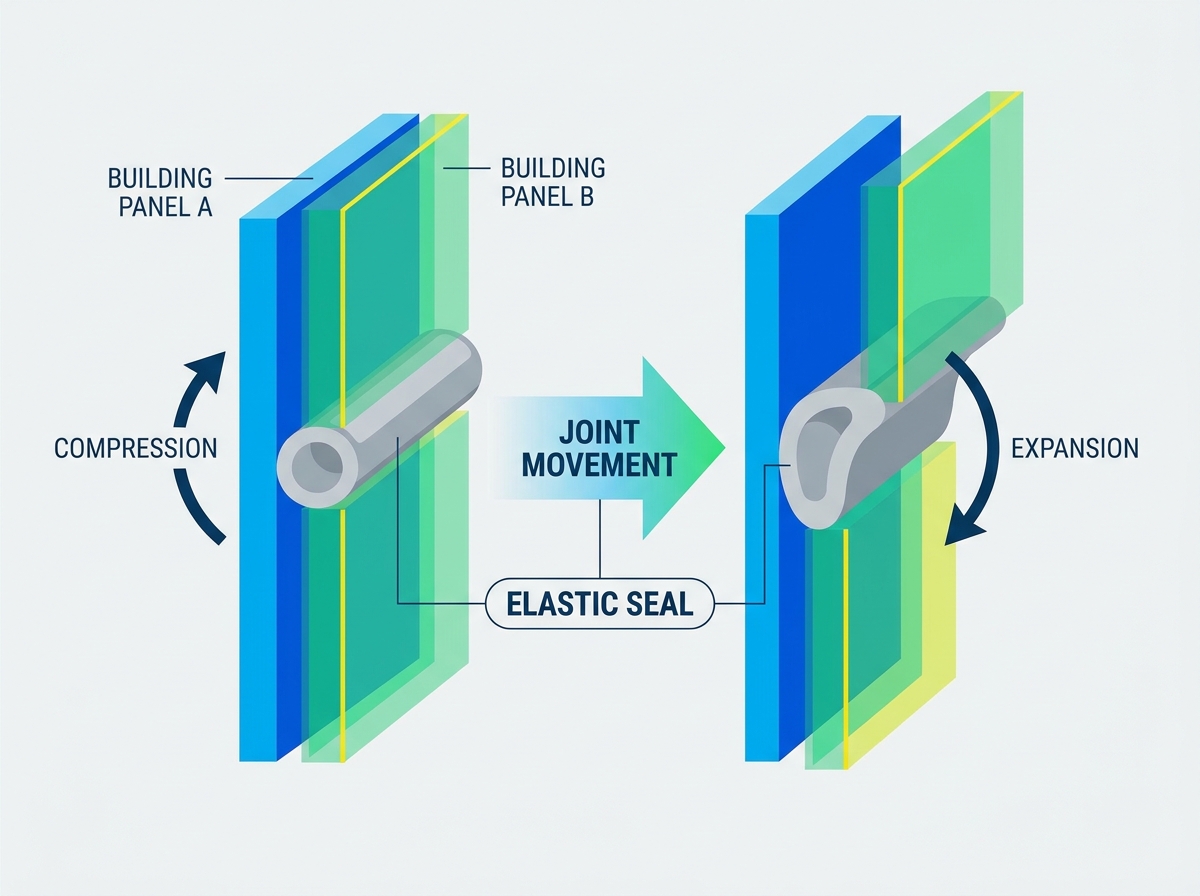
You must look past basic waterproofing when evaluating sealants for dynamic joints. High elastic recovery serves as the primary performance metric. When a joint compresses during the heat of the day, the sealant must squeeze together. When the joint expands at night, the sealant must stretch back to its original shape without permanent deformation. Materials lacking elastic recovery will sag, bulge, or permanently deform over time.
Modulus dictates how much stress the sealant transfers to the substrate during movement. A low-modulus sealant stretches easily, placing minimal stress on the bond line. Tear resistance prevents small nicks or surface abrasions from propagating through the entire sealant bead under tension. Long-term adhesion under continuous stress ensures the sealant maintains a watertight seal across decades of environmental exposure.
Sealant failure triggers a series of building envelope problems. The immediate consequence is water penetration. Moisture entering the wall cavity degrades insulation, reducing the building's thermal efficiency and increasing HVAC loads. Trapped moisture creates an ideal environment for mold growth, leading to indoor air quality issues and expensive remediation.
Structural degradation follows closely behind water ingress. When water penetrates concrete expansion joints and reaches the reinforcing steel, the steel rusts. Rust expands up to seven times the volume of the original steel, causing the surrounding concrete to spall and crack. In freeze-thaw climates, water trapped behind failed sealants freezes and expands, physically pushing facade components apart. Replacing failed sealants requires extensive labor to cut out the old material, grind the substrates clean, and reapply the new seal. Initial specification errors always result in heavy financial penalties later.
Silicone durability starts at the molecular level. Unlike organic sealants based on carbon-to-carbon bonds, silicone utilizes an inorganic siloxane backbone consisting of alternating silicon and oxygen atoms (Si-O). This specific chemical bond possesses significantly higher bond energy than carbon bonds. It requires much more energy to break down.
This inorganic structure gives silicone its exceptional elasticity and weather resistance. The polymer chains slide past each other easily, allowing the material to stretch and compress continuously without molecular degradation. Ultraviolet light from the sun carries enough energy to break organic carbon bonds, causing polyurethanes to harden and chalk over time. UV energy remains too weak to break the strong Si-O bonds, allowing silicone to maintain its flexibility for decades in direct sunlight.
Neutral silicone formulations cure through a reaction with atmospheric moisture. They contain no solvents, making them 100% solid materials. When extruded from the cartridge, the sealant absorbs water vapor from the ambient air. This moisture triggers the cross-linking agents within the formulation, linking the polymer chains together to form a solid, elastomeric rubber.
This solvent-free curing process yields several field advantages. The sealant does not shrink as it cures, ensuring the joint remains completely filled. It produces very low volatile organic compounds (VOCs), meeting strict indoor air quality standards for enclosed spaces. The curing byproducts evaporate harmlessly, leaving behind a highly durable seal safe for both interior applications and exposed outdoor environments. Installers must monitor ambient humidity, as extremely dry conditions will slow the curing process significantly.
Understanding the chemical differences between sealant types prevents catastrophic specification errors. Acetoxy silicone cures by releasing acetic acid. You can identify it by its strong vinegar odor. While fast-curing and effective for glass, acetic acid aggressively corrodes bare metals like copper, brass, and galvanized steel. When applied to concrete or masonry, the acid reacts with the alkaline substrate, forming a powdery interface that completely destroys adhesion.
Polyurethane sealants offer excellent abrasion resistance and accept paint readily. Their organic chemistry makes them susceptible to UV degradation. Over several years of sun exposure, polyurethanes harden, lose their elasticity, and eventually crack. They also tend to bubble if applied over damp substrates.
Neutral cure silicone eliminates these drawbacks. It cures by releasing alcohol or oxime, which are completely non-corrosive. It remains safe for sensitive metals, natural stone, and alkaline concrete. It retains the inherent UV stability of the siloxane backbone, outlasting organic alternatives in exterior applications.
Sealant Chemistry Comparison
Chemistry Type | Curing Byproduct | Substrate Compatibility | UV Resistance | Primary Drawback |
|---|---|---|---|---|
Neutral Cure Silicone | Alcohol or Oxime | Excellent (Metals, Stone, Concrete, Glass) | Exceptional | Cannot be painted |
Acetoxy Silicone | Acetic Acid | Limited (Glass, Glazed Ceramics only) | Exceptional | Corrodes metal, degrades concrete |
Polyurethane | None (Solvent evaporation or chemical cure) | Good (Concrete, Wood, some Metals) | Poor to Moderate | Hardens and cracks under UV exposure |
Industry standards like ASTM C920 classify sealants based on their tested movement capability. This rating dictates how much the joint can expand or compress from its original installed width without the sealant failing. Common classifications include ±25%, ±35%, and ±50%.
A ±25% rating indicates the sealant can safely accommodate a 25% increase or decrease in joint width. If you install this sealant in a 20mm wide joint, the joint can safely expand to 25mm (a 5mm increase) or compress to 15mm (a 5mm decrease). If the thermal variance of the building materials forces the joint to expand to 28mm, a ±25% rated sealant will likely tear or pull away from the substrate.
Matching the expected thermal variance to the correct movement class requires calculating the thermal expansion of the adjacent panels. Large aluminum facade panels subject to high temperature swings require high-movement sealants, often rated at ±50%. Smaller masonry units with lower expansion coefficients may only require a ±25% rating. Always design the joint width to ensure expected movement falls well within the sealant's rated capacity.
Modulus refers to the force required to stretch the sealant. Selecting the correct modulus depends entirely on the strength of the substrates forming the joint. Low-modulus sealants offer high stretchability with very low resistance. When the joint expands, the sealant stretches easily, placing minimal stress on the bond line. This makes low-modulus formulations ideal for weak or porous substrates like Exterior Insulation and Finish Systems (EIFS), soft limestone, or asphalt. If you use a stiff sealant on a weak substrate, the sealant will pull the face off the substrate before the sealant itself tears.
High-modulus sealants are stiffer and possess higher tensile strength. They resist movement more aggressively. These formulations suit high-stress areas where movement remains minimal but physical loads are high. Structural glazing applications rely on high-modulus silicone to hold heavy glass panels in place against wind loads. For general dynamic weatherproofing, low to medium modulus neutral cure silicones provide the best balance of flexibility and durability.
Modulus Application Guide
Modulus Level | Typical Substrates | Best Use Case | Movement Capacity |
|---|---|---|---|
Low Modulus | EIFS, Limestone, Brick, Concrete | High-movement expansion joints, weak substrates | High (Often ±50% to +100%/-50%) |
Medium Modulus | Aluminum, Glass, Precast Concrete | General weatherproofing, perimeter window seals | Moderate to High (±25% to ±50%) |
High Modulus | Glass, Structural Aluminum | Structural glazing, load-bearing joints | Low (Typically ±12.5% to ±25%) |
Building facades rarely consist of a single material. A single joint often bridges two completely different substrate profiles, such as porous concrete and non-porous extruded aluminum. The sealant must establish a permanent chemical and physical bond to both surfaces simultaneously.
Porous materials like brick and concrete present rough, microscopic textures. The sealant must wet out the surface, penetrating these pores to create a mechanical lock. Non-porous materials like glass and anodized aluminum offer smooth surfaces. Adhesion here relies heavily on chemical bonding. Neutral cure formulations excel in these mixed-substrate scenarios. Their non-acidic chemistry prevents adverse reactions with the alkaline concrete, while specific adhesion promoters in the formulation bond aggressively to the smooth metal.
The primary function of a construction weatherproof sealant is to maintain an impenetrable barrier against environmental extremes. Facade joints face brutal conditions. Surface temperatures on dark metal panels can exceed 80°C (176°F) in direct summer sunlight and drop below -20°C (-4°F) in winter. The sealant must not melt, sag, or become brittle across this entire temperature spectrum.
Ozone exposure and continuous ultraviolet light rapidly degrade inferior materials. Organic sealants undergo photo-oxidation, leading to surface chalking, micro-cracking, and eventual loss of adhesion. The inorganic nature of silicone completely resists this degradation. A properly applied silicone weatherseal remains flexible and watertight for twenty years or more, drastically reducing the frequency and cost of facade maintenance.
Specific architectural details require targeted sealant applications. Facade panel joints, where large precast concrete or metal composite panels meet, demand high movement accommodation. A wall joint silicone sealant absorbs the differential movement between these massive units, preventing wind-driven rain from entering the cavity.
Perimeter sealing of fenestrations represents another critical application. The joints around windows and doors bridge the gap between the frame and the wall structure. These joints experience complex shear forces as the building settles and thermal loads shift. Concrete expansion joints also rely heavily on elastomeric sealing. As concrete slabs expand in the heat, the sealant compresses. If a rigid filler were used, the expanding slabs would crush the filler and spall the concrete edges. The elasticity of silicone protects the adjacent concrete structures from mechanical damage.
Even the highest quality sealant will fail if applied into a poorly designed joint. The geometry of the sealant bead dictates its ability to stretch. The industry-standard rule requires a 2:1 width-to-depth ratio. The width of the joint must be exactly twice the depth of the sealant bead at its center.
For example, a 20mm wide joint requires a 10mm sealant depth. This specific geometry creates an hourglass shape when properly tooled. The hourglass shape ensures that when the joint expands, the stress concentrates in the middle of the sealant bead rather than at the bond line. If the sealant is applied too deeply, it becomes too stiff to stretch. The excessive mass of the sealant will resist movement, transferring immense stress to the substrate and causing adhesive failure.
Sealants must only adhere to two parallel surfaces—the sides of the joint. If the sealant adheres to the back of the joint as well, it suffers from three-sided adhesion. When the joint tries to expand, the sealant is locked in place at the back. It cannot stretch uniformly. This restriction forces the sealant to tear internally or rip away from the sides.
To prevent this, installers must use backer rods or bond breaker tapes. A closed-cell polyethylene backer rod serves two purposes. First, it establishes the correct depth for the 2:1 ratio. Second, silicone does not adhere to polyethylene. The backer rod acts as a bond breaker at the rear of the joint, allowing the sealant bead to stretch freely like a rubber band between the two parallel substrates. Always size the backer rod 25% larger than the joint width so it fits tightly and resists the pressure of the sealant gun.
Field installation errors routinely compromise sealant performance. Applying sealant over damp substrates traps moisture at the bond line, preventing chemical adhesion and causing the sealant to peel away as it cures. Inadequate surface preparation remains the leading cause of failure. Substrates must be completely free of dust, oils, old sealant residue, and laitance.
Follow these standard joint preparation and application steps to ensure success:
Grind or wire-brush porous substrates to remove laitance and loose debris.
Wipe non-porous substrates using the two-rag method with an approved industrial solvent.
Apply primer if required by the manufacturer's technical data sheet, allowing it to flash off completely.
Install the correctly sized closed-cell backer rod to achieve the 2:1 width-to-depth ratio.
Extrude the sealant evenly, pushing the bead ahead of the nozzle to fill all voids.
Tool the joint immediately with a dry spatula to force the sealant against the bond lines and create a concave profile. Never use soapy water for tooling.
Conduct documented field adhesion tests on actual project substrates before full-scale application to verify chemical compatibility.
Review the Technical Data Sheets (TDS) to confirm the specific movement ratings and modulus values match your expected thermal variance.
Verify all architectural drawings explicitly detail the required joint geometry, including the 2:1 width-to-depth ratio and precise backer rod placement.
Calibrate application equipment and train installation crews on the dry-tooling method to prevent bond line contamination.
A: Neutral cure silicone releases non-corrosive alcohol or oxime during curing, making it safe for metals, concrete, and stone. Acetoxy silicone releases acetic acid, which smells like vinegar. This acid corrodes bare metals and destroys adhesion on alkaline substrates like masonry and concrete.
A: Calculate the maximum expected thermal expansion of the adjacent building panels. Divide that movement value by the movement capability rating of the neutral silicone sealant. If panels move 5mm and the sealant is rated ±25%, the minimum joint width must be 20mm.
A: No. Standard silicone sealants cannot be painted. The low surface energy of the cured silicone prevents paint from adhering, causing it to bead up and peel off. You must select a sealant color that matches the facade or use a specific paintable hybrid formulation.
A: Premature failure usually results from improper joint design, such as ignoring the 2:1 width-to-depth ratio or allowing three-sided adhesion. Poor surface preparation, applying over damp substrates, and selecting a sealant with inadequate movement capability for the joint's thermal variance also cause rapid failure.
A: Yes. Its non-acidic chemistry will not react with alkaline concrete. A low-modulus neutral silicone easily accommodates the heavy thermal expansion and contraction of concrete slabs without tearing or pulling the concrete surface apart.
A: Neutral silicone cures from the outside in, relying on atmospheric moisture. It typically skins over within 30 minutes and cures at a rate of 2mm to 3mm per 24 hours at standard temperature and humidity. Deep joints may take several weeks to cure completely.
A: It depends on the substrate. While neutral silicone bonds well to many unprimed surfaces like glass and anodized aluminum, porous substrates like concrete or specialized fluoropolymer coatings often require a specific primer to achieve long-term adhesion. Always perform a field adhesion test.