+86-20-86215789 service@adhesive-dy.com

Views: 0 Author: Site Editor Publish Time: 2026-08-10 Origin: Site
Curtain wall engineering demands absolute precision. The structural integrity of the entire building envelope relies heavily on the exact specification of glazing joints. Engineers face a constant challenge balancing safety margins with material efficiency. Over-engineering leads to excessive material consumption and unnecessary weight on the framing. Under-calculating the structural bite risks catastrophic panel failure. High wind loads and severe thermal expansion expose these calculation errors quickly.
Rigorous calculation methodologies are mandatory to determine the exact structural bite required. These methods range from simplified industry-standard equations for standard panels to complex finite element analysis (FEA) for unique geometries. You must define this exact dimension before specifying and procuring materials. Accurate calculations ensure the joint can withstand decades of environmental stress without compromising the weather seal or the structural hold.
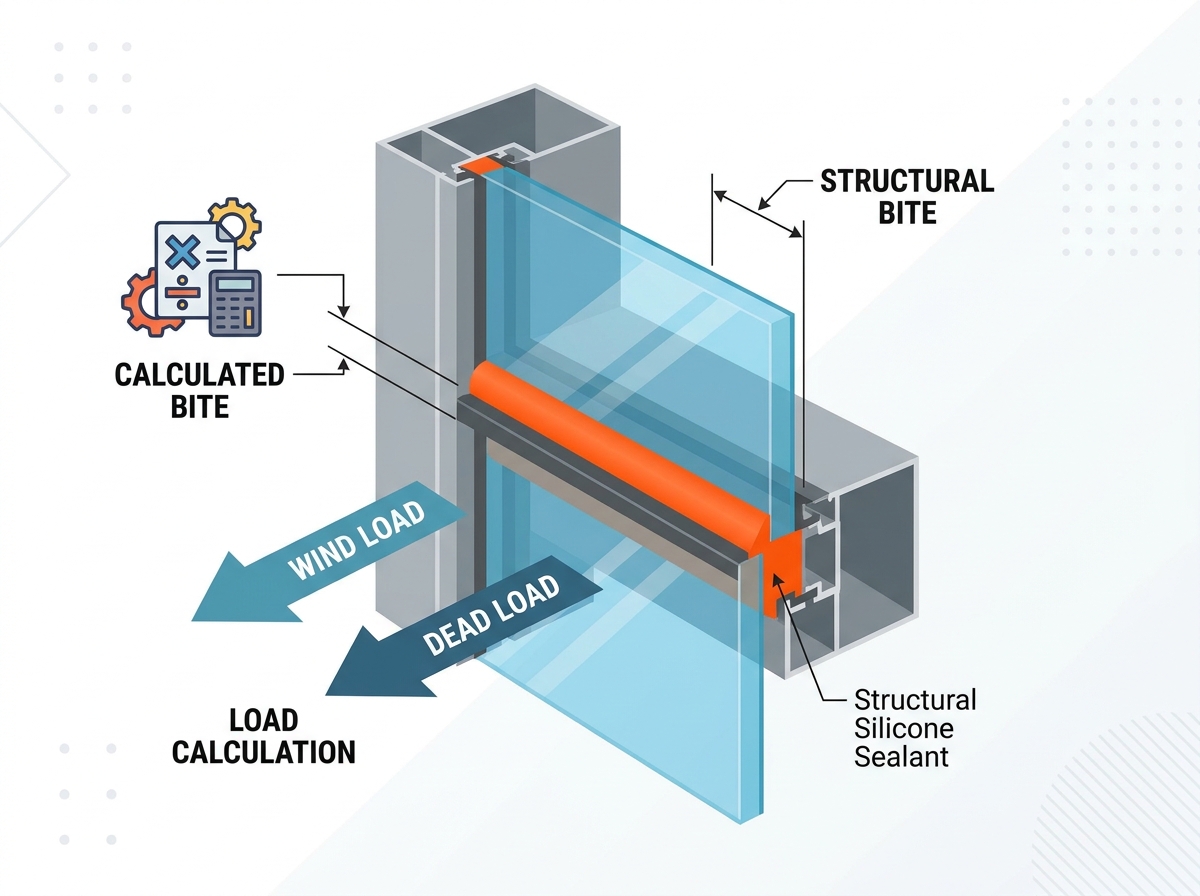
Bite vs. Thickness: Structural bite (contact width) resists wind and dead loads, while glueline thickness accommodates thermal movement; both must be calculated independently.
Calculation Methodologies: Standard trapezoidal load equations suffice for uniform rectangular panels, but complex geometries or high-wind-load zones require Finite Element Analysis (FEA).
Material Strength Dependencies: The required bite is inversely proportional to the design tensile strength of the specified curtain wall glazing sealant.
Application & Yield: Accurate bite calculations directly inform procurement volumes, dictating whether bulk drums, cartridges, or structural sausage silicone sealant packaging is the most cost-effective choice for shop or field application.
Structural bite is a fundamental dimension in facade engineering. We define structural bite as the minimum width of silicone sealant in direct contact with both the glass panel and the support frame. This specific contact area transfers applied loads from the glazing to the building structure. The bite dimension dictates the ultimate holding power of the joint. If the bite is too narrow, the sealant cannot distribute stress adequately. This leads to cohesive failure within the sealant body or adhesive failure at the bonding interface.
The sealant functions as a high-performance structural elastomer. It transmits dynamic wind loads across the facade. It absorbs seismic forces during ground movement. It also handles continuous dead loads from the insulated glass (IG) unit transferring weight to the aluminum framing. The elastomer must stretch and compress repeatedly without losing its original mechanical properties. The material absorbs these kinetic forces, preventing the brittle glass from bearing the stress directly.
A successful structural joint must meet several strict objectives simultaneously. First, it must maintain a continuous, unbroken weather seal against moisture and air infiltration. Second, the joint design must absolutely prevent any glass-to-metal contact under maximum deflection. Third, the internal stress levels must remain well below the sealant’s verified design strength during peak load conditions. Meeting these criteria ensures the facade remains intact and functional throughout the lifespan of the building.
When you walk a job site, you see the immediate impact of these design choices. Glaziers rely on the engineered bite to set their pump ratios and tooling depths. If the shop drawings specify a 12mm bite, the fabrication team must build the frame and set the glass to accommodate exactly 12mm of contact. Any deviation requires an engineering review. The structural silicone is the only thing holding that glass 40 stories above the street. It acts as both the adhesive and the structural support.
Local building codes establish the baseline requirements for wind load parameters. Building height, geographic location, and surrounding topography dictate the design wind load. Engineers usually express this load in kilopascals (kPa) or pounds per square foot (PSF). Wind load acts as the primary driver for structural bite dimensions. Higher elevations experience exponentially greater wind pressures. Corner zones of a building face severe negative wind loads (suction), requiring wider structural bite dimensions than the center zones of the same elevation.
Typical Wind Load Impact on Facade Zones
Building Zone | Relative Wind Pressure | Impact on Structural Bite |
|---|---|---|
Ground Level (Center) | Low to Moderate | Standard minimum bite usually sufficient. |
Mid-Rise (Center) | Moderate to High | Requires calculated bite based on specific elevation data. |
High-Rise (Corners) | Extreme (High Suction) | Demands significantly wider bite to resist negative pressure. |
Parapet / Roof Line | Extreme (Turbulence) | Often requires FEA modeling to account for vortex shedding. |
Glass panel dimensions heavily influence load distribution. The short span, or the width of the glass panel, plays a critical role in the calculation. Stress distribution models assume the shortest distance to the framing bears the highest load concentration. Therefore, a tall, narrow glass panel will transfer wind loads differently than a perfectly square panel. The calculation must account for the maximum stress transferred along the longest edge of the short span.
The thickness of the individual glass panes impacts the overall dead load. The composition of the Insulated Glass (IG) unit adds significant weight. You must differentiate between two distinct structural seals in an IG unit. The primary structural sealant holds the individual panes of the IG unit together. The secondary structural sealant attaches the entire assembled IG unit to the aluminum framing. Both require independent bite calculations based on their specific load-bearing responsibilities.
Design tensile strength is a fixed material property. The standard industry design strength for a Structural Silicone Sealant is typically 20 psi (138 kPa) for dynamic loads. This conservative value includes a significant safety factor, usually 5:1 or 6:1, based on the material's ultimate tensile strength. Utilizing sealants with higher verified tensile strengths can mathematically reduce the required structural bite. However, engineers must verify these higher strength values through rigorous third-party testing before applying them to facade calculations.
The industry relies on a standard trapezoidal load equation for straightforward glazing projects. The formula is: Bite = (Wind Load × Short Span of Glass) / (2 × Design Tensile Strength of Sealant). You must ensure all units of measurement align before executing the calculation. If wind load is in PSF and the span is in inches, the design tensile strength must be in PSI. This formula provides the absolute minimum structural bite required to resist the specified wind load safely.
Follow these exact steps to execute the hand calculation:
Determine the design wind load for the specific elevation and zone of the building.
Measure the short span of the largest glass panel in that zone.
Identify the design tensile strength of your chosen sealant.
Multiply the wind load by the short span.
Multiply the design tensile strength by two.
Divide the result of Step 4 by the result of Step 5.
Compare the calculated bite against the manufacturer's minimum requirement and round up if necessary.
Regardless of the mathematical output, industry standards enforce strict minimums. The absolute minimum structural bite is typically 1/4 inch (6mm). If the trapezoidal equation yields a result of 4mm, you must round up to 6mm. This minimum dimension ensures an adequate adhesion surface area. It also provides a baseline safety margin against minor fabrication variances or substrate irregularities.
This hand calculation carries specific limitations. It assumes a perfectly uniform stress distribution along the entire length of the sealant joint. The equation is only applicable for standard, flat, rectangular four-sided structural glazing. It cannot account for stress concentrations at corners or the complex load paths found in curved glass applications. Using this formula for irregular shapes will result in inaccurate and potentially dangerous joint dimensions.
Advanced modeling becomes mandatory when standard equations fall short. Scenarios requiring FEA include curved glass panels, asymmetrical shapes, and oversized architectural units. Extreme high-wind-load zones, such as hurricane-prone coastal regions, also demand FEA. In these situations, stress does not distribute uniformly. Wind loads create severe localized stress spikes that simplified formulas completely ignore.
FEA simulates the structural sealant glazing joints using sophisticated volume elements. The software applies hyperelastic material laws to model the exact behavior of the silicone under stress. This allows engineers to identify peak stress concentrations accurately. By visualizing how the elastomer deforms under varying load conditions, engineers can adjust the joint geometry. They can thicken the bite in specific high-stress zones while maintaining standard dimensions elsewhere, optimizing both safety and material usage.
Structural silicone sometimes supports the dead weight of the glass. This occurs in unsupported systems where setting blocks are absent. When the sealant bears the dead load, you must perform a separate calculation. Dead loads are continuous, unlike intermittent wind loads. Therefore, the design shear strength used for dead load calculations is much lower, typically limited to 1 psi (7 kPa). This prevents the sealant from creeping or sagging over decades of continuous stress.
Glueline thickness is entirely distinct from structural bite. Bite resists wind; thickness accommodates movement. You calculate glueline thickness based on the coefficient of thermal expansion (CTE) of the substrates. You must determine the maximum expected temperature variance and the panel dimensions. The thickness must be sufficient to allow the sealant to stretch and compress within its rated movement capability (often ±25% or ±50%) without tearing. A joint that is too thin will fail cohesively during extreme temperature shifts.
The formula for glueline thickness is: Thickness = (Long Span of Glass × Coefficient of Thermal Expansion × Temperature Change) / Movement Capability of Sealant. Aluminum frames expand and contract significantly more than glass. This differential movement creates shear stress across the sealant joint. If you have a 3-meter tall glass panel and a 50-degree Celsius temperature swing, the aluminum will grow much faster than the glass. The sealant must be thick enough to absorb this shear movement without exceeding its rated capacity.
The choice between single-component and multi-component systems dictates your production workflow. 1-part moisture-cured systems rely on atmospheric humidity to cure. They cure slowly, typically from the outside in. This makes them ideal for field glazing, repairs, or small-scale shop fabrication where rapid handling is not required. 2-part systems utilize a base and a curing agent. They offer a rapid, uniform cure throughout the entire joint depth. 2-part systems are mandatory for high-volume factory glazing where units must be moved and shipped quickly.
Performance trade-offs exist between the two formulations. 2-part systems generally achieve higher ultimate tensile strength and faster adhesion build. They require expensive, specialized pump equipment to ensure exact mixing ratios. 1-part systems are easier to apply without specialized mixing gear but require longer staging times before the glass can be moved. Both formulations, when properly cured, provide excellent long-term durability and UV resistance.
Comparison of 1-Part and 2-Part Silicone Systems
Feature | 1-Part Silicone System | 2-Part Silicone System |
|---|---|---|
Cure Mechanism | Moisture-cured (atmospheric humidity) | Chemical reaction (base + catalyst) |
Cure Speed | Slow (days to weeks for full depth) | Rapid (hours to full handling strength) |
Application Environment | Field glazing, repairs, small shop | High-volume factory fabrication |
Equipment Required | Standard caulking guns, sausage guns | Specialized meter-mix pump systems |
Mixing Ratio Control | Not applicable (pre-mixed) | Critical (requires daily butterfly testing) |
Accurate bite and thickness calculations directly inform your project-wide volume estimation. To calculate the required volume per panel, use a perimeter-based formula. Multiply the total perimeter length of all four sides by the calculated structural bite and the calculated glueline thickness. Divide this total joint volume by the volume of your chosen packaging unit. Finally, multiply this figure by the total number of glass plates on the project. Add a standard 10% to 15% waste factor to account for nozzle loss and joint variations.
Format selection impacts labor efficiency and material waste. Bulk drums (55-gallon) are the only logical choice for factory pumps due to economy of scale. For field applications, cartridge packaging is common but generates significant plastic waste. Specifying a structural sausage silicone sealant provides a highly efficient alternative. Sausage foils compress completely during extrusion, minimizing leftover material and reducing disposal volume on the job site.
Material compliance is non-negotiable in structural glazing. You must select a curtain wall glazing sealant that strictly complies with ASTM C1184. This standard specification dictates the minimum physical properties required for structural applications, including tensile strength, tear resistance, and extreme temperature stability. Sealants lacking this certification pose a severe liability risk and should never be used for structural load transfer.
Project-specific testing guarantees long-term performance. You must send actual production samples of your substrates to the sealant manufacturer. This includes the specific coated glass, the anodized or painted aluminum framing, and any setting blocks or gaskets. The manufacturer will perform verified adhesion and compatibility testing. They will confirm that the sealant bonds properly without requiring a primer, or they will specify the exact primer needed. They will also verify that adjacent materials (like gaskets) will not leach plasticizers and degrade the structural silicone over time.
Under-calculating the glazing joint dimensions leads to catastrophic outcomes. If the structural bite is too narrow, the wind load will exceed the sealant's tensile strength. This causes cohesive failure, where the sealant tears itself apart internally. If the glueline thickness is too thin, thermal expansion will shear the joint. Cyclic wind loading exacerbates these calculation errors, leading to premature fatigue and eventual panel detachment.
Poor substrate preparation will destroy a perfectly calculated joint. Structural silicone requires a pristine surface to achieve chemical adhesion. Dust, cutting oils, moisture, or fingerprint oils act as bond breakers. If the aluminum or glass is not cleaned using the two-rag wipe method with an approved solvent, the sealant will suffer adhesive failure. The joint will look intact visually, but it will peel away from the substrate under minimal load.
Common Glazing Joint Defects and Causes
Defect Type | Visual Indicator | Root Cause |
|---|---|---|
Adhesive Failure | Sealant peels cleanly off the glass or aluminum. | Poor surface cleaning, missing primer, or incompatible substrate. |
Cohesive Failure | Sealant tears down the middle; remains bonded to both sides. | Insufficient structural bite or excessive joint movement. |
Streaking / Marbling | White or black swirls visible in the cured sealant body. | Failing static mixer or incorrect pump ratio on 2-part systems. |
Reversion | Sealant turns gummy or liquid after initial cure. | Plasticizer migration from incompatible adjacent gaskets. |
Strict quality control protocols mitigate these installation risks. Implement a rigorous QA/QC program during fabrication. Conduct daily butterfly tests for 2-part systems to visually confirm proper mixing ratios and eliminate streaking. To perform a butterfly test, fold a piece of paper in half, apply a bead of mixed 2-part sealant to the crease, and press the paper flat. Pull the paper apart and examine the sealant. It should be a uniform color without any white or black streaks. Streaks indicate a failing static mixer or incorrect pump ratios. You must perform this test every time you start the pump or change a drum.
Perform regular snap-time tests to verify cure rates. Execute destructive peel adhesion tests on production frames to confirm bond strength. For peel adhesion testing, apply a bead of sealant to the actual production substrate. Embed a wire mesh screen or a strip of fabric into the wet sealant, leaving a tail. Apply another layer of sealant over the mesh. Let it cure completely. Pull the tail back at a 180-degree angle. The sealant must tear cohesively rather than peeling cleanly off the substrate. Finally, conduct periodic deglazing tests on fully cured units to measure the actual structural bite and ensure it matches the engineered calculations.
Calculating structural silicone bite requires precise mathematical alignment between building loads, panel geometry, and verified material properties. Estimation has no place in facade engineering. The integrity of the curtain wall depends entirely on the accuracy of these joint dimensions and the quality of the applied sealant.
Procurement and engineering teams must evaluate materials rigorously. Shortlist sealants based on documented ASTM C1184 compliance and verified design tensile strength. Prioritize manufacturers who offer comprehensive project-specific testing and robust warranty support.
Consult a licensed structural engineer to verify site-specific wind load requirements.
Calculate both structural bite and glueline thickness independently using approved methodologies.
Submit all production substrates to the sealant manufacturer for adhesion and compatibility testing.
Establish a daily QA/QC testing log for all shop and field glazing activities.
A: The absolute minimum structural bite recognized by industry standards is typically 1/4 inch (6mm). Even if load calculations suggest a smaller dimension is sufficient, you must default to this minimum to ensure adequate adhesion surface area and a baseline safety margin.
A: Glueline thickness is calculated based on the expected thermal movement. You multiply the panel's longest dimension by the substrate's coefficient of thermal expansion and the maximum expected temperature change. The resulting movement must not exceed the sealant's rated movement capability.
A: Structural bite is the contact width between the sealant and the substrate, designed to resist wind and dead loads. Glueline thickness is the depth of the sealant between the glass and the frame, designed to absorb thermal expansion and contraction.
A: Yes, structural silicone in sausage packaging is fully capable of 4-sided structural glazing, provided the specific product meets ASTM C1184 standards. It is often preferred for field glazing and repairs due to its low waste profile.
A: The standard industry design tensile strength for structural silicone is typically 20 psi (138 kPa) for dynamic wind loads. This conservative figure includes a significant safety factor to ensure long-term durability under cyclic loading.
A: Wind load dictates the required structural bite. Higher wind loads exert greater pressure (or suction) on the glass panel. To safely transfer this increased force to the framing without exceeding the sealant's strength, the structural bite must be widened.
A: FEA is used when standard equations cannot accurately predict stress distribution. It is essential for complex geometries, curved glass, asymmetrical panels, or extreme high-wind-load zones where localized peak stress concentrations occur.