+86-20-86215789 service@adhesive-dy.com

Views: 0 Author: Site Editor Publish Time: 2026-08-22 Origin: Site
Adhesive failure in manufacturing operations carries a heavy operational cost. Delamination, extensive rework, and scrapped materials drain resources rapidly. These failures often stem from improper adhesive selection rather than poor application technique. Bonding dissimilar materials presents a unique technical challenge on the production floor. You must frequently join rigid laminates, oil-rich leather, and solvent-sensitive foam within the same assembly. Traditional curing adhesives fail in these scenarios because they cannot provide immediate handling strength. Production lines cannot afford to wait hours for a chemical cure. You need a reliable, fast-acting solution to maintain throughput. Contact Adhesive provides the industry-standard, rubber-based formulation for instant, high-shear bonding upon impact. It eliminates complex clamping systems and drastically reduces assembly time. Selecting the correct formulation and mastering the application methodology ensures a permanent, structural bond across varying porosities and flexibilities.
Mechanism of Action: Contact adhesives are rubber-based formulas that require application to both substrates and a specific "flash time" to allow solvent evaporation before mating, creating an instant auto-adhesive permanent bond with no waiting for a curing period.
Formulation Dictates Application: Neoprene contact adhesive is optimal for high-heat, rigid applications (laminates, metal, wood), while SBS contact adhesive excels in high-tack, flexible applications (foam, rubber, and textiles).
Substrate Vulnerabilities: Proper selection mitigates specific material risks, such as solvent-induced foam degradation or plasticizer migration in leather.
Process Control is Critical: Bond failure is rarely a product defect; it is typically a failure to control surface preparation, coat weight, open time, or mating pressure.
Defining success criteria for structural bonds requires understanding the physical constraints of your assembly process. Clamping is often impossible due to the geometry of the parts. In other cases, clamping is highly inefficient and disrupts the continuous flow of production. You need a bonding agent that holds parts together immediately. Auto-adhesion provides this exact capability. This chemical mechanism relies on rubber-based polymer chains suspended in a carrier fluid. When you apply the film to both surfaces, the carrier evaporates. Upon physical contact, the polymer chains on one surface entangle instantly with the identical chains on the opposing surface. They fuse together permanently. They require no additional chemical curing, heat activation, or cross-linking post-mating.
This instant green strength fundamentally changes assembly line dynamics. It eliminates bottlenecking at bonding stations. Operators can mate two coated substrates, apply pressure, and immediately move the assembly to the next routing or trimming phase. The permanent bond forms upon initial impact. The cohesive strength of the adhesive film exceeds the tear strength of many flexible substrates almost immediately. This rapid strength development prevents parts from shifting, sliding, or separating during subsequent handling. We see this constantly in panel lamination. Waiting for standard PVA glue to cure creates massive staging requirements. Auto-adhesion removes that staging entirely.
The choice of carrier fluid dictates the drying speed and facility requirements. Solvent-based carriers evaporate rapidly. They flash off in minutes, leaving behind a tacky polymer film ready for bonding. However, they possess higher volatile organic compound (VOC) profiles. Facilities using solvent-borne systems require robust ventilation and strict fire safety protocols. Water-based carriers offer a safer, low-VOC alternative. They eliminate flammability risks and reduce environmental impact. The trade-off involves significantly slower evaporation rates. Water-borne systems often require forced air movement or infrared heating banks to accelerate the flash time and maintain production speed.
Carrier Fluid Comparison
Carrier Type | Evaporation Rate | VOC Profile | Facility Requirements |
|---|---|---|---|
Solvent-Borne | Fast (2-5 minutes) | High | Explosion-proof ventilation, strict fire safety |
Water-Borne | Slow (15-30 minutes) | Low to Zero | Standard ventilation, forced air/heat tunnels |
You must evaluate the physical and chemical properties of your substrates before selecting an adhesive. Different materials react uniquely to solvents, heat, and mechanical stress.
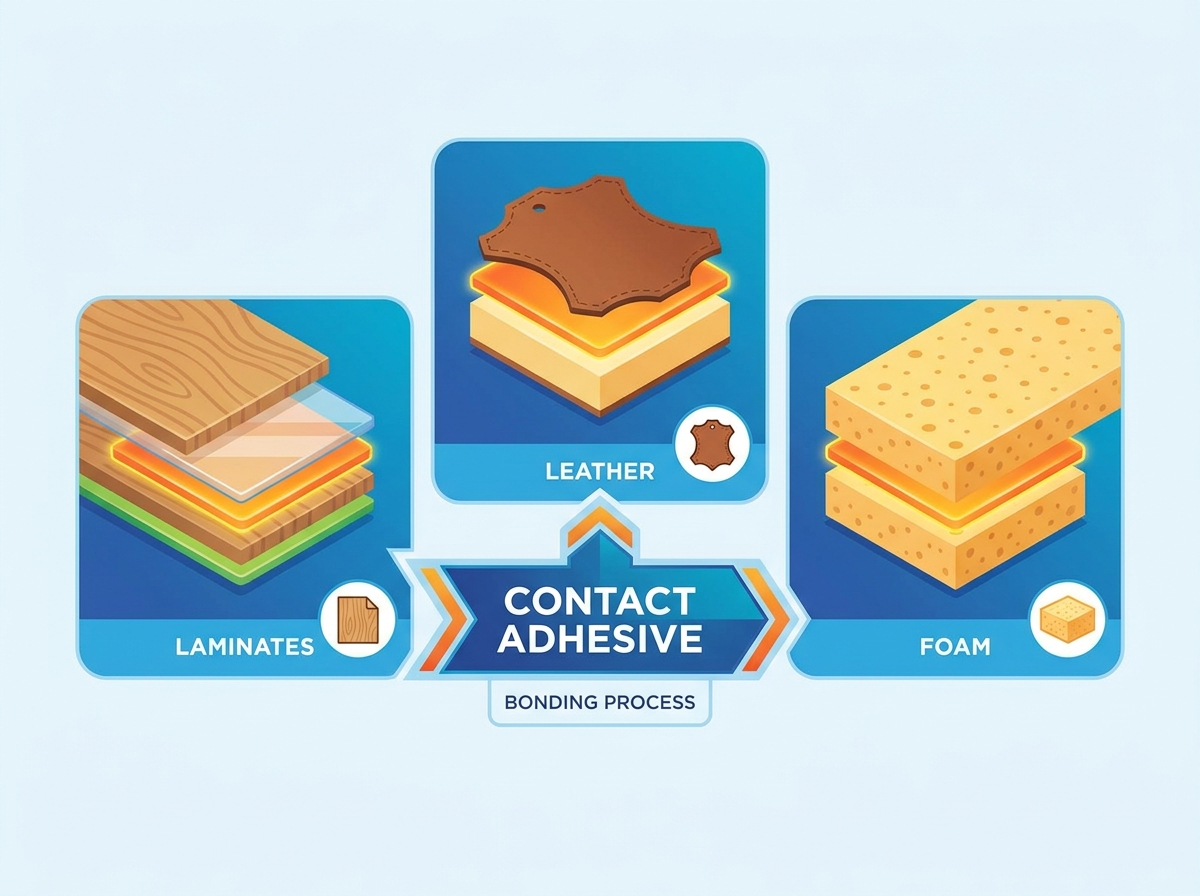
Bonding high-pressure laminates (HPL), Formica, and rigid plastics demands specific performance characteristics. The primary success criteria include exceptionally high shear strength and absolute resistance to edge lifting. Laminates often undergo stress from routing, trimming, and daily use. Furthermore, assemblies like countertops or architectural panels require high thermal resistance. They must withstand direct sunlight, machinery heat, or hot objects placed on the surface without the adhesive softening. Rigid substrates, including metal-to-wood or laminate-to-particleboard assemblies, transfer stress directly to the bond line. You must select adhesives with high cohesive strength and minimal creep. Creep occurs when an adhesive slowly stretches under continuous load. A creeping adhesive allows laminates to shift, creating unsightly gaps and eventual delamination.
Working with leather, synthetic rubber, and heavy textiles introduces a different set of bonding challenges. The success criteria shift toward the flexibility of the bond line. A rigid adhesive layer will crack or alter the natural drape of the fabric. Resistance to natural oils is also mandatory. Leather contains natural fats and tanning oils that can degrade certain polymers over time. You must also prevent telegraphing. Telegraphing happens when a thick or uneven adhesive line shows through the surface of a thin or supple material, ruining the aesthetic finish. The most severe evaluation lens focuses on plasticizer migration. Flexible PVC, synthetic rubbers, and treated leathers contain plasticizers to maintain their softness. These plasticizers can migrate out of the substrate and into the adhesive film. This chemical migration softens the adhesive, turning it into a sticky, failing mess over months or years. You must select formulations specifically engineered to block plasticizer migration.
Bonding foam and highly porous materials requires a delicate balance of properties. The success criteria demand high initial tack to grab the lightweight material instantly. You must achieve a low coat weight to prevent stiffening the foam assembly. Heavy adhesive application creates hard seams that ruin the comfort or acoustic properties of the foam. Strict chemical compatibility remains the most critical factor. The primary evaluation lens focuses on the risk of solvent attack or melt. Aggressive solvents found in many standard adhesives will rapidly dissolve polyurethane or expanded polystyrene (EPS) foams. The solvent collapses the cellular structure, leaving behind a cratered, destroyed substrate. You must utilize specific adhesive formulations designed with mild solvents or water-based carriers to safely bond foam materials.
Follow these evaluation steps when assessing new substrates:
Identify the maximum temperature the finished assembly will endure.
Determine the porosity of both mating surfaces.
Check for the presence of plasticizers in flexible materials.
Test a small foam sample for solvent melt before full application.
Adhesive Formulation Comparison
Performance Feature | Polychloroprene Base | Styrene-Butadiene-Styrene Base |
|---|---|---|
Heat Resistance | Excellent (up to 250°F+) | Moderate (up to 160°F) |
Initial Tack | Moderate to High | Extremely Aggressive |
Bond Line Flexibility | Rigid and Firm | Soft and Highly Flexible |
Primary Substrates | HPL, Metal, Wood, Veneers | Foam, Fabric, Upholstery, Leather |
Polychloroprene formulations deliver exceptional durability for demanding environments. The performance profile features outstanding heat resistance, often withstanding temperatures exceeding 250 degrees Fahrenheit. This polymer base offers excellent chemical and oil resistance. It provides a very high ultimate shear strength, locking rigid materials firmly in place. The best use cases involve high-stress, rigid assemblies. You will use neoprene contact adhesive for HPL, Formica, wood veneers, automotive interiors, and metal-to-wood bonding. We rely on this chemistry for commercial countertop fabrication where edge banding faces constant impact and heat. However, this formulation comes with specific trade-offs. It generally exhibits a slower tack time, requiring a slightly longer wait before mating. The cured bond line is stiffer, which can negatively impact the feel of soft textiles. Additionally, polychloroprene formulations typically carry a higher material cost.
Styrene-Butadiene-Styrene block copolymers offer a completely different performance dynamic. The performance profile highlights extremely fast drying times. It develops an aggressive initial tack almost immediately upon flashing off. The resulting bond line remains soft, pliable, and highly flexible. These formulations often feature a high solids content, providing excellent coverage on porous surfaces. The best use cases center around flexible material assembly. You will rely on SBS contact adhesive for upholstery, acoustic foam laminating, mattress manufacturing, and lightweight textile bonding. In furniture manufacturing, this rapid tack allows operators to wrap complex curves without the fabric pulling back. The trade-offs involve thermal and chemical limitations. SBS polymers possess lower heat resistance compared to polychloroprene. They can fail if exposed to sustained high temperatures. They are also more susceptible to degradation from certain oils, solvents, and migrating plasticizers.
Achieving a structural bond requires strict adherence to application protocols. Skipping steps leads directly to delamination.
Proper surface preparation dictates the ultimate success of the bond. You cannot bond to dirt, oil, or loose debris. Mechanical abrasion is mandatory for rigid plastics and metals. Scuffing the surface with 80-grit to 120-grit abrasives increases the surface area and creates a mechanical profile for the adhesive to grip. Solvent wiping remains critical for removing invisible contaminants. Use an approved solvent like acetone or isopropyl alcohol to strip away mold release agents, machine oils, and ambient dust prior to application. Ensure the solvent fully evaporates before applying the adhesive film. Clean surfaces ensure maximum wet-out and optimal polymer entanglement.
Applying the correct coat weight requires the right equipment and technique. You must apply an even, consistent coat to both mating surfaces. Applying adhesive to only one surface will result in immediate failure. Aim for 80 to 100 percent coverage on both substrates. The film should look uniform without heavy pooling or dry spots.
Application Method Comparison
Method | Best For | Coverage Characteristics |
|---|---|---|
Spray (Canister/Bulk) | Large panels, high-volume production | Consistent web-like pattern, fast application |
Manual Roller | Flat surfaces, medium-volume work | Even film build, requires low-nap solvent-resistant covers |
Brush | Edge banding, precision touch-ups | Heavier coat weight, prone to uneven application |
Managing the flash time is the most critical variable in the bonding process. You must define the exact window between solvent evaporation and the expiration of the adhesive's open time. The surface must feel dry and tacky to the touch. Perform the knuckle test. Press your knuckles firmly against the adhesive film. If any adhesive transfers to your skin, the solvents have not fully evaporated. If you wait too long, the open time expires, and the adhesive loses its ability to auto-adhere. Ambient temperature and humidity heavily impact this drying window. Hot, dry conditions accelerate flash time. Cold, damp conditions extend the waiting period significantly. Always monitor your facility's climate.
Once the adhesive flashes off, you must execute the mating process accurately. You only get one chance. The parts will grab instantly upon contact. Align the substrates carefully before allowing them to touch. Use dowel rods or slip sheets to keep large panels separated during alignment. Once aligned, remove the separators and initiate contact. High, uniform pressure is mandatory to finalize the bond. Hand pressure is rarely sufficient for structural assemblies. Use a heavy J-roller, a nip roller, or a pinch roller system. Roll from the center outward to the edges. High pressure forces the two adhesive films into intimate contact. This mechanical force activates the auto-adhesion process, crushes the adhesive nodes together, and eliminates trapped air bubbles.
Even with the right adhesive, environmental factors and application errors can compromise the assembly. You must recognize these risks and implement corrective actions immediately.
Blushing occurs when high humidity disrupts the drying process. As volatile solvents evaporate rapidly, they draw heat away from the substrate. This rapid cooling drops the surface temperature of the adhesive below the ambient dew point. Condensation forms instantly on the cooling adhesive surface. This trapped moisture acts as a barrier between the two polymer films, leading to catastrophic bond failure. The adhesive will look cloudy or milky. To mitigate blushing, you must control ambient humidity in the application area. Keep relative humidity below 60 percent. If you cannot control the humidity, consider using a slower-evaporating solvent blend or a water-based alternative. You can also introduce ambient heat to keep the substrate temperature above the dew point.
Starved joints plague assemblies involving highly porous substrates. Materials like open-cell foam, wood end-grain, or suede absorb liquids rapidly. When you apply a standard coat weight, the porous material wicks the adhesive deep into its structure. This leaves insufficient adhesive on the surface to form a bond with the mating part. The resulting starved joint separates easily under minimal stress. You must adjust your application technique for porous materials. Apply a thin primer coat and allow it to flash off completely. This first coat seals the pores. Then, apply a second, standard coat to build an adequate adhesive film on the surface.
Impatience leads directly to trapped solvents. Mating substrates before adequate flash time seals the evaporating carrier fluid inside the assembly. The solvents continue to turn into gas, but they have nowhere to escape. This trapped gas exerts outward pressure on the bond line. The immediate consequence is blistering. Gas bubbles form under flexible surfaces like laminates or veneers. Over time, the trapped solvents degrade the polymer chains, resulting in delayed delamination. The bond may hold initially but will fail weeks or months later. Always utilize the knuckle test to verify complete evaporation before mating.
Industrial bonding operations must navigate strict safety and environmental regulations. The chemicals involved require proper handling and facility infrastructure.
The regulatory landscape regarding volatile organic compounds strictly governs solvent-based adhesives. Organizations like the EPA, the Ozone Transport Commission (OTC), and the South Coast Air Quality Management District (SCAQMD) enforce stringent limits on VOC emissions. These regulations aim to reduce smog formation and improve indoor air quality. You must verify that your chosen formulation complies with local and regional environmental guidelines. Manufacturers formulate specific low-VOC solvent blends to meet these varying regional requirements without sacrificing bond strength. Using non-compliant adhesives can result in heavy fines and facility shutdowns.
Understanding the flammability of your carrier fluid is vital for facility safety. Solvent carriers vary drastically in their fire risk. Hexane, acetone, and toluene blends are highly flammable. They require explosion-proof lighting, specialized ventilation, and strict grounding protocols to prevent static sparks. Conversely, solvents like methylene chloride are non-flammable. They eliminate the fire risk but carry significant health warnings regarding inhalation toxicity. You must differentiate between these carriers and implement the associated facility safety requirements. This includes providing proper personal protective equipment (PPE) like respirators and ensuring adequate air exchange rates in the spray booth.
Many facilities eventually transition to low-VOC or water-based contact adhesives to meet compliance goals. Evaluating the operational trade-offs is crucial before making the switch. Water-based acrylic or polyurethane dispersions eliminate flammability and drastically reduce VOCs. They are excellent for foam laminating and general assembly. However, they require significantly longer drying times. Water evaporates much slower than chemical solvents. To maintain production speed, you will likely need to install forced air fans or infrared heating tunnels. You must balance the environmental benefits against the necessary equipment upgrades and process adjustments.
Conduct peel and shear testing on actual production substrates in your facility's ambient conditions before full-scale procurement.
Verify your facility's temperature and humidity controls to prevent blushing and ensure consistent flash times.
Request technical data sheets (TDS) from the manufacturer to confirm specific open times and VOC compliance.
Consult an adhesive engineer to validate your formulation choice against your exact production line speeds and substrate materials.
A: SBS offers extremely fast drying, aggressive initial tack, and a highly flexible bond line, making it ideal for foam and upholstery. Neoprene provides superior heat resistance, chemical resistance, and high ultimate shear strength, making it the standard for rigid laminates, metal, and wood.
A: The flash time typically ranges from 2 to 15 minutes depending on the solvent carrier, ambient temperature, and humidity. The adhesive is ready when it feels dry and tacky to the touch, and no adhesive transfers to your knuckle when pressed firmly against the surface.
A: Yes, standard solvent-based formulations contain aggressive chemicals like hexane or toluene that will rapidly dissolve and melt polyurethane or polystyrene foams. You must use specific foam-compatible formulations designed with mild solvents or water-based carriers to prevent substrate destruction.
A: Yes, it excels at bonding these materials. Neoprene formulations are best for metal and wood due to their high shear strength and heat resistance. SBS formulations are better suited for rubber and flexible materials where a pliable bond line is required.
A: Bond failure usually results from process errors. Common causes include inadequate surface preparation, mating the parts before the solvents fully evaporated, applying insufficient adhesive on porous materials, or failing to apply adequate pressure with a roller during mating.
A: You must apply high, uniform pressure across the entire bond line to activate auto-adhesion. Hand pressure is insufficient. Use a heavy J-roller, nip roller, or pinch roller to apply at least 25 to 50 PSI. This crushes the adhesive nodes together and expels trapped air.