+86-20-86215789 service@adhesive-dy.com

Views: 0 Author: Site Editor Publish Time: 2026-08-16 Origin: Site
Improper gap sealing creates massive operational risks in both commercial and residential construction. Thermal bridging drains energy efficiency rapidly. Unchecked draughts destroy interior climate control. Moisture ingress rots structural timber and breeds mold. Acoustic leakage ruins privacy between partitioned spaces. Ultimately, failed building inspections halt projects entirely and force costly rework. Selecting the correct sealant formulation remains a constant challenge for contractors and facility managers. Treating all expanding foams as interchangeable guarantees failure. Wrong choices cause distorted window frames. They compromise critical fire barriers. They invite pest infestations and accelerate premature material degradation.
We must apply a strict technical framework to solve these sealing challenges. You need to evaluate expansion rates, cell structure, and fire ratings accurately. You must understand adhesive properties and application-specific constraints. This guide breaks down exactly how to match the right formulation to windows, plumbing penetrations, and complex rooflines. You will learn how to secure airtight, code-compliant seals across every building envelope penetration.
Formulation Dictates Application: Low-expansion foams are mandatory for window and door frames to prevent bowing, while high-yield foams suit static structural voids and ceiling gaps.
Code Compliance is Non-Negotiable: Pipe penetrations and HVAC runs frequently require certified fire resistant polyurethane foam to maintain compartmentalization and pass inspection.
Dual Functionality (Sealant & Adhesive): Beyond gap-filling, specific PU foam formulations act as high-strength construction adhesives for insulation boards and drywall.
Moisture is the Catalyst: Standard 1-component PU foams require ambient humidity and surface moisture to cure correctly; failing to manage moisture leads to structural collapse of the foam.
UV Degradation is Inevitable: All exposed PU foam requires secondary finishing (paint, sealant, or cladding) to prevent rapid breakdown from ultraviolet light exposure.
A successful building seal must meet strict performance baselines. Airtightness stands as the primary requirement. Blocking air movement stops convective heat loss and reduces HVAC loads. Thermal insulation requires specific R-values per inch to prevent thermal bridging across gaps. Acoustic dampening blocks airborne noise transfer between rooms or from exterior sources. Structural adhesion ensures the sealant grips the substrate firmly under stress. Finally, the seal must accommodate natural building movement. Substrates expand and contract daily. The cured foam must flex without tearing or detaching from the cavity walls.
Meeting these criteria demands precision. You cannot simply inject foam and hope it holds. You must assess the cavity depth, substrate material, and environmental exposure. A successful application integrates seamlessly into the broader building envelope strategy. It acts as a continuous barrier against the elements. Proper installation ensures long-term durability and maintains the structural integrity of the surrounding components.
Before pulling the trigger on any dispensing gun, field crews should execute a standard site assessment. Skipping these steps leads to blowouts, uncured centers, and failed inspections. Follow this sequence to evaluate the void:
Measure the maximum width and depth of the cavity to determine if a backing material is necessary.
Identify the substrate materials to ensure chemical compatibility and proper adhesion.
Determine the ambient humidity and surface moisture levels to confirm they meet the minimum requirements for 1-component curing.
Verify local building codes for specific fire or acoustic ratings required for the penetration.
Select the appropriate dispensing method based on the volume of the void and the required precision of the bead.
Contractors often debate between using expanding foam and traditional caulks. Silicone, acrylic, and polyurethane caulks handle surface joints exceptionally well. They provide high flexibility for surface-level, high-movement joints. They also offer superior natural UV resistance. However, traditional sealants fail in deep cavities. They cannot bridge wide gaps without slumping or requiring excessive backing material like closed-cell backer rods. Applying thick beads of caulk wastes material and rarely cures properly in the center.
PU Foam fills large voids efficiently. It expands to occupy irregular spaces where caulk cannot reach. It provides superior thermal insulation and creates strong adhesive bonds for gaps larger than 1/4 inch. Expanding foam acts as a three-dimensional plug. It seals the width, depth, and height of a cavity simultaneously. Traditional sealants only cap the surface. Understanding this trade-off prevents material failure in deep structural voids.
Comparison of Gap Sealing Materials
Material Type | Ideal Gap Size | Insulation Value | UV Resistance | Movement Capability |
|---|---|---|---|---|
Expanding Polyurethane Foam | Greater than 1/4 inch | High (High R-value) | Low (Requires coating) | Moderate |
Silicone Caulk | Less than 1/4 inch | Low | High | Very High |
Acrylic Latex Caulk | Less than 1/4 inch | Low | Moderate | Low to Moderate |
Polyurethane Caulk | 1/4 to 1/2 inch | Low | High | High |
High-expansion formulations expand aggressively, sometimes up to 300% of their extruded volume. They fill large, irregular cavities rapidly. You should use them for rough openings in non-load-bearing walls. They insulate rooflines and ceiling penetrations perfectly. They excel at general draught exclusion in basements and attics. The rapid expansion saves time when addressing massive voids. Field crews rely on these high-yield cans to seal corrugated roof deck flutes and wide rim joist gaps where precision takes a back seat to sheer volume.
However, all purpose expanding foam has strict limitations. High expansion pressure warps delicate substrates easily. It can bow window jambs and push door frames out of alignment. The massive expansion also results in a lower cured density. Lower density yields lower structural rigidity and reduced compressive strength. You must reserve this formulation for static voids where expansion pressure will not damage surrounding materials.
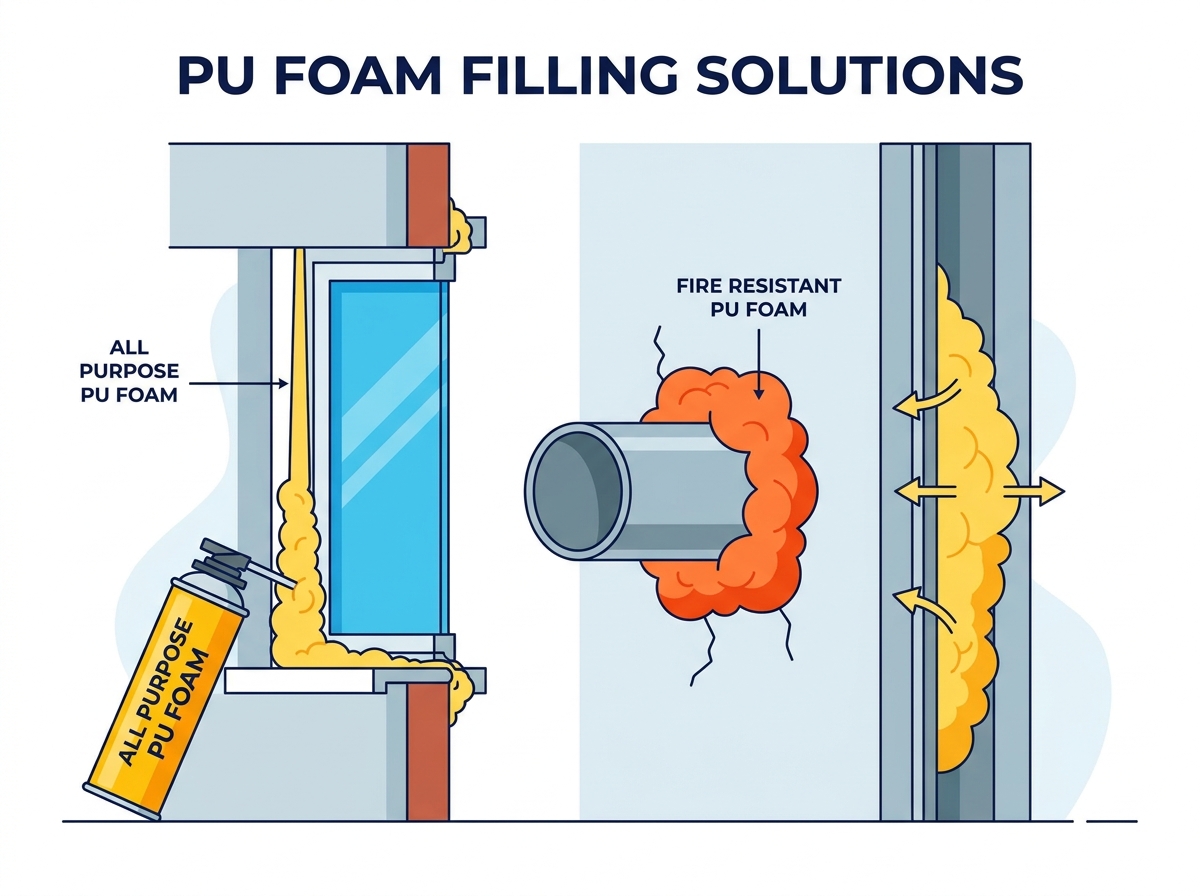
Controlled-expansion formulations expand significantly less, typically under 20-30%. Manufacturers engineer these specifically for fenestration. They seal the annular space between rough openings and window or door frames. The chemistry limits the outward force exerted during the curing phase. This controlled reaction prevents structural deflection. When installing heavy, multi-pane glazing units, maintaining the exact factory tolerances of the frame is non-negotiable. Even a millimeter of deflection can cause the locking mechanisms to fail.
The primary performance metric is pressure limitation. The foam must exert minimal deflection pressure to ensure windows and doors remain perfectly plumb. Sashes must remain fully operable after the foam cures. Using standard high-expansion foam here guarantees jammed windows and misaligned door latches. Low-expansion foam provides the necessary insulation and airtightness without compromising the mechanical function of the frame. It also features a denser cell structure, which improves acoustic dampening around exterior openings.
Building codes demand strict compartmentalization to prevent fire spread. Standard foam acts as fuel during a fire. Formulations containing specialized fire-retardant additives solve this problem. These foams meet rigorous certifications like B1 or B2 DIN 4102 ratings. They comply with ASTM E814 or UL 1479 standards for through-penetration firestops. Inspectors will immediately flag and fail any commercial penetration that uses standard combustible foam in a fire-rated assembly.
Use them to seal electrical conduits. Isolate plumbing pipes and HVAC ductwork penetrations crossing fire-rated walls and floors. fire resistant polyurethane foam features critical intumescent properties. It expands rapidly when exposed to extreme heat. This secondary expansion chokes off oxygen and blocks flames from passing through the void. It maintains the integrity of the fire barrier for the required hourly rating. When sealing PVC pipes, the intumescent action crushes the melting plastic, completely sealing the hole left behind.
Foam technology extends beyond simple gap filling. Some formulations act purely as high-strength construction adhesives. They extrude as a foam but quickly collapse into a dense, high-strength gel. This secures insulation boards, drywall, and landscaping blocks. It replaces heavy, traditional mastic adhesives. The foam adhesive cures faster and provides a stronger bond on uneven surfaces. It eliminates the need to haul heavy buckets of adhesive up scaffolding.
Pest-deterrent foams address biological threats. Standard foam provides no resistance to rodents. Mice and rats chew through standard polyurethane easily to access warm buildings. Pest-block formulations incorporate bittering agents. These chemical additives prevent rodent chewing. They block pest entry points effectively without using toxic baits. The foam seals the draught while simultaneously repelling the infestation. We frequently deploy these formulations around ground-level utility penetrations and crawlspace vents.
Formulation Selection Matrix
Application Area | Recommended Formulation | Primary Benefit | Key Limitation |
|---|---|---|---|
Window & Door Frames | Low-Expansion Foam | Prevents frame bowing | Lower overall yield per can |
Attic Baffles & Rooflines | All-Purpose High-Yield | Fills massive voids quickly | High expansion pressure |
HVAC & Plumbing Chases | Fire-Resistant Foam | Maintains fire compartmentalization | Requires specific depth for code |
Drywall & Insulation Boards | Collapsing Foam Adhesive | High bond strength, fast cure | Minimal gap-filling capability |
Understanding cell structure dictates long-term performance. Closed-cell foams feature tightly packed, isolated bubbles. They deliver high R-values per inch, typically ranging from R-4 to R-5. They act as robust vapor barriers and provide excellent water resistance. The rigid structure adds minor structural support to the cavity. Use closed-cell formulations for exterior applications, basement rim joists, and areas prone to moisture exposure. The density of closed-cell foam also makes it highly resistant to air infiltration under heavy wind loads.
Open-cell foams feature interconnected bubbles. They remain softer and more flexible after curing. They offer superior acoustic dampening properties, achieving higher STC (Sound Transmission Class) ratings. The flexibility accommodates significant building movement without cracking. However, open-cell foams remain vulnerable to moisture absorption. They act like sponges if exposed to standing water. Never use open-cell foam in below-grade exterior applications or areas lacking a dedicated vapor barrier. Reserve open-cell products for interior partition walls where sound isolation is the primary goal.
Polyurethane foam chemistry relies heavily on environmental factors. 1-Component (1K) foams dominate the market. They rely entirely on atmospheric humidity and surface moisture to cure. The moisture triggers an exothermic chemical reaction. Without sufficient moisture, the foam cures on the outside but remains liquid inside. This causes eventual shrinkage and seal failure. In arid climates or during winter construction, crews must artificially introduce moisture by misting the substrates before application.
2-Component (2K) foams utilize internal chemical cross-linking. The canister mixes a resin and a hardener at the nozzle. They cure independently of ambient moisture. This offers significantly faster cure times, often becoming tack-free in under 60 seconds. It provides higher density and uniform cell structure regardless of environmental conditions. Use 2K foams for critical structural applications, deep enclosed cavities, and cold-weather installations where ambient humidity is too low for 1K foams. The rapid cure time allows crews to trim and finish the foam almost immediately, accelerating the project schedule.
Evaluating foam efficiency requires looking beyond the volume printed on the can. You must calculate true efficiency based on extruded yield. A heavier can does not always produce more cured foam. The expansion ratio and propellant mixture determine the final linear footage. Always check the manufacturer's Technical Data Sheet (TDS) for accurate yield estimates based on bead size. Temperature heavily impacts yield. Cold cans produce significantly less foam than cans stored at the optimal 70°F.
Cured density correlates directly with thermal resistance and physical strength. Higher density closed-cell foams increase compressive strength. They improve the overall R-value of the assembly. Lower density foams provide better yield per canister but sacrifice insulation value and rigidity. Match the density to the structural requirement of the void you are filling. To maximize yield and performance on site, follow these preparation steps:
Store canisters in a climate-controlled environment between 65°F and 80°F for 24 hours prior to use.
Shake the canister vigorously for a minimum of 60 seconds to mix the prepolymer and propellant thoroughly.
Clear the valve and attach the dispensing gun securely to prevent propellant leaks.
Adjust the metering screw on the gun to match the required bead size for the specific joint.
Apply a test bead on scrap material to verify expansion rate and cell structure before filling the actual void.
Window and door installations require strict adherence to application protocols. Do use only low-expansion foam for these delicate substrates. Apply the material in distinct layers or beads. Position the nozzle approximately one inch from the interior face of the frame. Allow the foam to expand naturally into the void. Utilize shims between the frame and the rough opening until the foam fully cures. The shims prevent any minor expansion pressure from bowing the jambs. Leave the shims in place for at least 24 hours.
Don't over-fill the cavity with aggressive expanding foam. Contractors often make the mistake of injecting too much material to save time. This leads to irreversible frame distortion. The pressure bows the wood or vinyl inward. It renders sashes completely inoperable and breaks the weatherstripping seal. Always fill the cavity to a maximum of 30% to 50% capacity and let the foam expand to fill the rest. If you see foam aggressively pushing out of the gap, you have applied too much material.
Plumbing and HVAC penetrations experience constant thermal and mechanical stress. Do select highly flexible or fire-rated foam for these areas. Ensure the foam depth matches local building code requirements. Different pipe materials require specific depths to maintain firestop ratings. PVC pipes melt during a fire, requiring intumescent foam to crush the melting pipe and seal the hole. Copper pipes transfer heat rapidly, requiring different firestop depths. Always center the pipe in the penetration to ensure a uniform annular space for the foam to fill.
Don't apply rigid foams around hot water pipes or steam lines. Thermal expansion and contraction cause the pipes to move constantly. Rigid foam cannot accommodate this movement. The thermal cycling will shatter the foam's cell structure. It breaks the airtight seal completely, allowing draughts and smoke to pass through the penetration. Always use high-flexibility formulations for dynamic plumbing runs. Never apply standard foam directly against flue pipes or chimney chases where temperatures exceed the foam's maximum service rating.
Filling massive voids requires moisture management and patience. Do lightly mist the substrate with water prior to application. The added surface moisture accelerates the curing process and improves adhesion. Apply the foam in concentric layers. Allow each layer to tack over before adding more volume. This ensures uniform curing throughout the entire depth of the cavity. For voids deeper than three inches, wait at least 30 minutes between layers to allow ambient moisture to reach the curing foam.
Don't fill deep, dry cavities in a single pass. Injecting a massive volume of 1K foam into a dry void causes incomplete curing. The outer layer skins over, blocking moisture from reaching the center. It creates a mushy center effect. The foam structure eventually collapses inward, pulling away from the cavity walls and destroying the airtight seal. Layering prevents this catastrophic failure. If you encounter a massive void, consider using a rigid foam board insert first, then sealing the perimeter with expanding foam to reduce material usage.
Common Application Failures and Solutions
Failure Symptom | Root Cause | Field Solution |
|---|---|---|
Foam collapses after extrusion | Lack of ambient moisture or cold can | Mist substrate with water; warm can to 70°F |
Window frame bows inward | Used high-expansion foam or overfilled | Cut out foam, re-shim frame, use low-expansion foam |
Foam pulls away from substrate | Dusty/oily surface or excessive joint movement | Clean substrate thoroughly; use flexible formulation |
Foam turns orange and brittle | Prolonged UV exposure | Trim damaged foam and apply opaque sealant or paint |
Choosing the right dispensing method impacts application efficiency and material waste. Straw applicators suit one-off, low-volume tasks. They come pre-attached to retail canisters. However, straws suffer from poor metering. You cannot control the flow rate accurately. Once you start a straw can, you must usually finish it. The foam cures inside the straw, rendering the remaining material useless and generating excessive waste. The lack of an internal shut-off valve means the foam continues to ooze long after you release the trigger.
Professional foam guns offer precise flow control. A needle valve regulates the exact bead size. They produce better cell structure due to consistent internal mixing. You can pause work indefinitely without ruining the canister. Simply close the valve, and the foam remains liquid inside the gun. This precision eliminates overfilling, reduces cleanup time, and maximizes the yield of every canister on large commercial projects. Maintaining the gun requires flushing it with a dedicated polyurethane solvent cleaner only when removing an empty can for long-term storage. Otherwise, leave a partially full can attached to keep the system pressurized and airtight.
Proper finishing ensures the longevity of the foam seal. Wait for a full cure before cutting or trimming the foam. The tack-free stage occurs quickly, but the core remains soft for hours. Cutting early collapses the delicate cell structure and breaks the airtight seal. Wait at least 12 to 24 hours, depending on humidity, before applying a knife to the expanded material. Use a serrated blade to cut the foam flush with the substrate. A clean cut provides a better surface for secondary sealants.
Mandatory finishing steps protect the installation from environmental degradation. Polyurethane foam possesses zero natural UV resistance. Sunlight breaks down the chemical bonds rapidly. The foam turns orange, becomes brittle, and turns to dust within months. Apply elastomeric sealants, plaster, or exterior-grade paint over all trimmed foam. This prevents UV degradation, stops water pooling, and blocks pest intrusion. For exterior window perimeters, apply a high-quality silicone or polyurethane caulk directly over the trimmed foam to create a dual-barrier weather seal.
Audit your current inventory immediately and remove all high-expansion foams from window and door installation kits to prevent frame distortion.
Mandate the use of professional gun applicators for all commercial sealing tasks to eliminate material waste and improve bead precision.
Review local fire codes to determine the exact depth requirements for intumescent foam on all plumbing and electrical penetrations.
Implement a mandatory 24-hour curing hold before allowing crews to execute any trimming, cutting, or finishing work on expanded foam.
Establish a standard operating procedure to mist all dry substrates with water prior to applying 1-component foams to guarantee a full cure.
A: The primary difference lies in expansion pressure and volume. All-purpose formulations expand aggressively to fill large voids quickly, which easily warps delicate frames. Window and door foams are low-expansion, low-pressure formulations. They fill the annular space without exerting outward force, ensuring sashes and doors remain perfectly plumb and fully operable.
A: No. Standard foam degrades under continuous high heat and shatters from the thermal expansion of the pipes. You must use certified fire-rated foams or high-temperature silicone sealants depending on the exact heat output and local building code requirements for that specific penetration.
A: Shrinkage usually occurs due to inadequate ambient moisture during application. Standard 1K foams require humidity to cure properly. If applied in deep, dry cavities without misting the substrate, the center fails to cure, causing the foam to collapse inward and pull away from the walls.
A: No. While closed-cell formulations are highly water-resistant and excellent for blocking moisture vapor and draughts, they are not primary waterproofing membranes. They will not stop active hydrostatic pressure or flowing water. Active leaks require hydraulic cement or specialized waterproofing injection resins.
A: Standard foam becomes tack-free in 10 to 15 minutes. It is generally trimmable with a knife in 1 to 2 hours. However, it requires a full 24 hours to cure completely through the core. Cutting it before a full cure collapses the internal cell structure and ruins the seal.
A: Foam does not attract pests as a food source. However, standard foam provides zero resistance to rodents. Mice and rats will easily chew through it to access a building. To stop pests, you must use a specialized pest-block formulation containing bittering agents or integrate steel wool into the gap.
A: Yes. Specific formulations are engineered purely as high-strength construction adhesives. They extrude as foam but collapse into a dense gel. They are excellent for bonding drywall, insulation boards, and landscaping blocks, effectively replacing traditional heavy mastic adhesives on the job site.